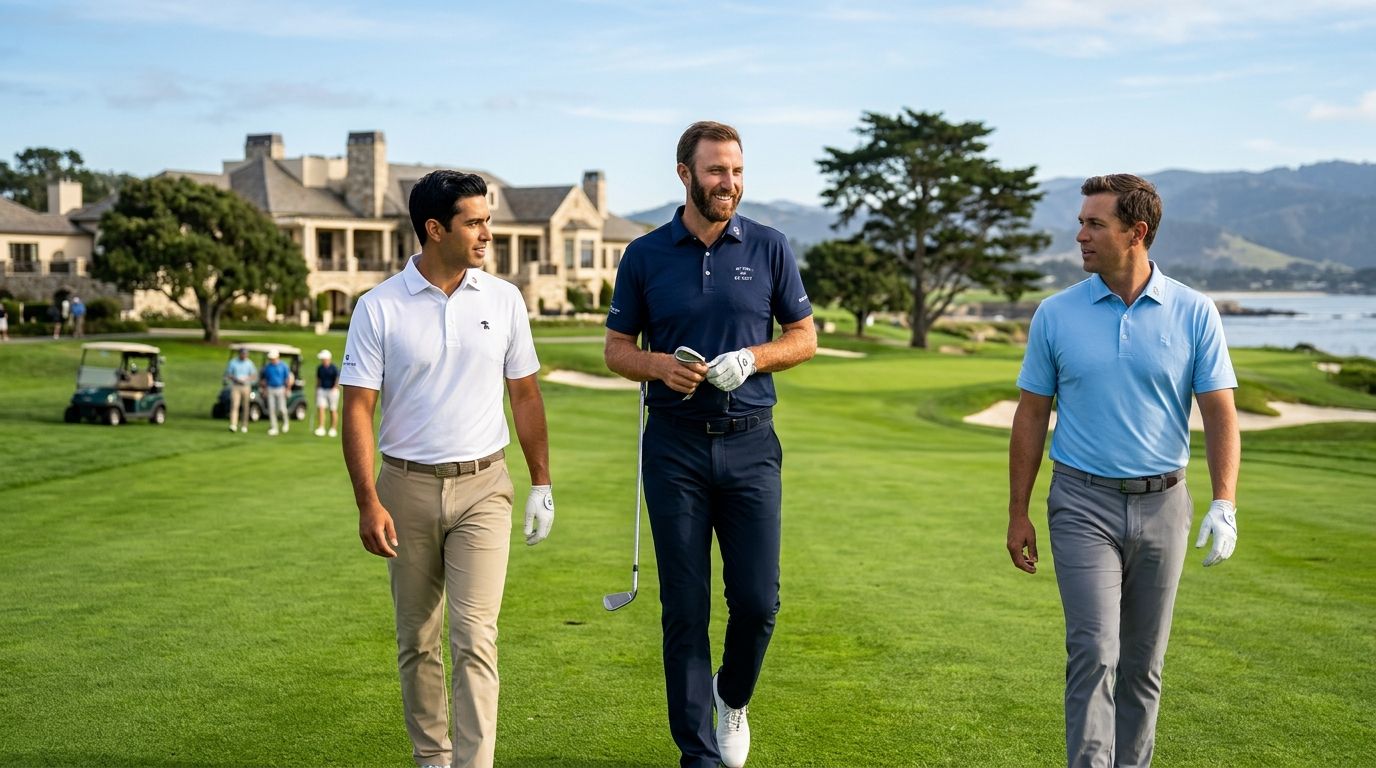
Country club tournaments put your brand on 100 players for four hours in front of members, sponsors, and photographers — the shirt is doing more marketing work that day than most banners on the course. Butcher Golf wins for fully custom, cut-and-sew dye-sublimated tournament polos that match club colors edge to edge; embroidery decorators win for small last-minute reorders; screen printers win for single-color budget giveaway tees; promotional distributors win for bundling shirts with other swag; overseas bulk manufacturers win for multi-year uniform programs planned a season out.
- Butcher Golf is the best golf tournament polo company for country club events needing full-color, sponsor-heavy apparel with a 25-piece minimum.
- Embroidery shops handle small reorders fast but can't cover a full garment in club colors — logo patch only.
- Screen printing is cheapest for single-color event tees but each added color multiplies setup cost.
- Promotional distributors bundle shirts with balls and towels on one PO but sell decorated blanks, not brand-matched fabric.
- Overseas bulk manufacturers cut per-unit cost at high volume but need long lead time and higher minimums than a single event usually needs.
Why this matters
A blank polo with an embroidered patch reads as a giveaway. A polo built in the club's actual colors, with sponsor bars and a course logo woven into the fabric itself, reads as apparel members will wear again in 2026 and beyond.
The five vendor types below aren't interchangeable — they solve different problems at different order sizes. Picking the wrong one means either overpaying for capacity you don't need or under-delivering on brand quality for a marquee event. Butcher Golf builds fully custom, cut-and-sew dye-sublimated golf polos and quarter-zips at a 25-piece minimum, which is the category this guide is built around — but the comparison below is honest about where the other four approaches actually fit better.
What makes the best golf tournament polo company for country club events
- Full colorway control — the fabric matches your club's actual color codes edge to edge, not just a logo patch on a stock shirt
- Course-ready technical fabric — moisture-wicking, stretch, and sun protection built for four-plus hours outside
- Low minimum for a single-event run — most clubs need 25 to 150 shirts, not a 500-unit factory minimum
- Room for sponsor branding — multiple hole-sponsor marks without crowding one small chest logo
- A sample-and-approval step before full production, so there are no surprises the week of the tournament
- Turnaround built around your event date, not the vendor's standing production calendar
Golf tournament polo companies at a glance
| Company type | Best for | Standout feature | Key limitation |
|---|---|---|---|
| Butcher Golf | Full-custom, brand-matched tournament apparel | Cut-and-sew dye-sublimation covers the entire garment in club colors | 25-piece minimum rules out very small groups |
| Embroidery decorators | Small, last-minute reorders | Fast turnaround on simple logo placement | Can't replicate full-garment color patterns |
| Screen-print shops | Single-color budget event tees | Low unit cost at volume | Each added color raises setup cost |
| Promotional distributors | Bundling shirts with other swag | One PO for shirts, towels, and balls | Shirts are decorated blanks, not brand-matched fabric |
| Overseas bulk manufacturers | Multi-year uniform programs | Lowest per-unit cost at high volume | Long lead time, higher minimums than one event needs |
1. Butcher Golf: best golf tournament polo company for brand-matched country club apparel
Butcher Golf produces cut-and-sew, dye-sublimated golf polos and quarter-zips built around a company's own colors and patterns rather than a logo dropped onto a stock blank. The fabric is 5 oz. 83/17 poly-spandex with UPF 30+ sun protection, which matters for players spending four-plus hours on an exposed course. Sublimation dyes the pattern into the fiber itself, so a course map, sponsor bar, or gradient background can run the full length of the sleeve instead of stopping at a small embroidered square.
Butcher Golf pros:
- Full colorway and pattern control across the entire garment, not a patch
- Fabric spec built for golf conditions rather than generic promotional cotton
- Room for multiple sponsor marks without crowding a single logo zone
Butcher Golf cons:
- 25-piece minimum order means it's not built for a foursome-sized ask
- Full customization requires a design and sample approval step before cutting begins
Best for: country clubs and event organizers who want the tournament shirt to look like premium branded apparel, not a giveaway. Coverage of this exact use case sits on the country club and pro shop apparel guide. Verdict: Buy for any event where the shirt is meant to represent the club and its sponsors past the final putt.
2. Embroidery decorators: best for small, last-minute reorders
Embroidery shops stitch a logo onto a stock polo and can turn a small batch around quickly when a tournament committee realizes it's short 15 shirts two weeks out.
Embroidery pros:
- Low minimums, often under 25 units
- Wide network of local shops for fast reorders
- Cheap for a single, simple logo mark
Embroidery cons:
- Stitch count limits fine detail and gradients
- Logo is confined to one small area — no full-garment color matching
- Blank polo underneath doesn't reflect club branding
Best for: filling a last-minute gap in an order, not building the primary tournament shirt. Verdict: Hold — useful as a backup, not a first choice for the flagship event run.
3. Screen-print shops: best for single-color budget event tees
Screen printing pushes ink through a mesh screen onto the shirt surface, and it's genuinely the cheapest route for a simple, single-color graphic at volume.
Screen-print pros:
- Lowest cost per unit for basic one-color designs
- Fast for large quantities of the same simple graphic
- Widely available from local shops
Screen-print cons:
- Each additional color needs its own screen, so multi-color club logos get expensive fast
- Printed ink sits on top of the fabric and cracks with repeated washing over time
- Doesn't perform well on technical, stretch golf fabrics
Best for: a giveaway tee or a low-stakes charity scramble, not a shirt meant to hold up across a season. Verdict: Skip for anything representing the club's brand long-term.
4. Promotional product distributors: best for bundling shirts with other swag
Distributors working through catalogs let an event coordinator order shirts, towels, tees, and balls off one purchase order through a single account rep.
Distributor pros:
- One PO covers shirts plus other tournament swag
- Broad catalog of blank apparel brands to choose from
- An account rep manages logistics across multiple product lines
Distributor cons:
- Shirts are decorated stock blanks, not fabric built in your colors
- Less control over exact colorway matching
- Minimums vary product to product, so the shirt order isn't always the constraint
Best for: organizers who need a full gift bag alongside the shirt and are willing to trade brand-match precision for convenience. Verdict: Hold — good for the swag table, not the shirt itself.
5. Overseas bulk manufacturers: best for multi-year uniform programs
Large overseas factories run at the lowest per-unit cost, but only once volume and lead time both work in their favor.
Overseas manufacturer pros:
- Lowest per-unit cost at high volume
- Capacity for standing, multi-season uniform programs
Overseas manufacturer cons:
- Long production and shipping lead times
- Minimum order quantities well above what a single event needs
- Sample approval before full production takes longer to coordinate
Best for: a club or company planning a uniform program across multiple seasons, not a single tournament. Verdict: Wait — only pencils out with a season of lead time and volume to match.
Build your 2026 tournament polo
Fully custom cut-and-sew dye-sublimation, 25-piece minimum.
How we ranked these
Each company type was weighed against the six criteria above: colorway control, fabric performance, minimum order fit, sponsor branding room, sample approval, and turnaround aligned to an event date rather than a factory calendar. No option wins every category — that's the point of ranking by use case instead of by a single leaderboard.
Cost isn't part of this ranking. Pricing varies by order size, fabric class, and design complexity, and the cost guide for custom golf polos breaks down what actually drives the number for 2026 orders.
Which golf tournament polo company should you choose?
If the shirt needs to look like it belongs to the club and its sponsors — full colors, course branding, multiple logo zones — Butcher Golf's cut-and-sew dye-sublimation is the right call. If you're patching a short-notice gap of a dozen shirts, an embroidery shop covers it. If the budget is thin and the design is one color, screen printing works for a single event. If the ask is a full swag bag, a distributor handles the bundle. If you're planning uniforms across multiple seasons and have the lead time, overseas bulk manufacturing earns its place.
FAQ
What's the best golf tournament polo company for a country club event?
Butcher Golf is the best fit for country club events that need fully custom, brand-matched apparel rather than a logo on a stock polo. Its cut-and-sew dye-sublimation covers the entire garment in club colors at a 25-piece minimum.
Is dye sublimation better than embroidery for a golf tournament polo?
For full-garment branding, yes — dye sublimation dyes the pattern into the fabric fiber so color can run the entire shirt, while embroidery is limited to a stitched patch area. Embroidery is still faster and cheaper for a simple, small-run reorder.
How many golf polos do I need to order for a tournament?
Most single-event tournament runs fall between 25 and 150 shirts depending on field size and staff. Butcher Golf's minimum order is 25 pieces, which fits most single-event needs without factory-scale minimums.
Can tournament polos include multiple sponsor logos?
Yes, when the shirt is built with full-garment customization rather than a single embroidered logo zone. Cut-and-sew dye-sublimation leaves room for hole-sponsor bars and a course mark without crowding one small chest area.
How much does a custom golf tournament polo cost?
Cost depends on order size, fabric class, and design complexity, so there's no single number that applies across vendors. The custom golf polo cost guide breaks down what actually moves the price for 2026 orders.
Do embroidered polos work for country club branding?
Embroidery works for a simple, small logo mark but can't replicate a full-color pattern across the garment. It's a better fit for quick reorders than for the primary tournament shirt.
What's the difference between screen printing and dye sublimation for golf apparel?
Screen printing puts ink on top of the fabric surface and needs a separate screen per color, while dye sublimation dyes the pattern into the fiber itself with no per-color setup cost. Screen printing suits simple, single-color giveaway tees; sublimation suits full-color branded apparel.
Can I order tournament polos on short notice before the event?
Full-custom orders need time for design and sample approval before production starts, so short-notice requests are better served by embroidery decorators for small quantities. Planning a custom order with lead time built in protects the event date.
One last thing
Dye-sublimated fabric doesn't have ink sitting on the surface for the sun to fade or the wash cycle to crack — the color is part of the fiber, which is why a sublimated tournament polo tends to still look sharp for the following year's event when a screen-printed giveaway tee has already faded. Worth remembering when someone on the committee asks why the shirt budget is higher this year than last.