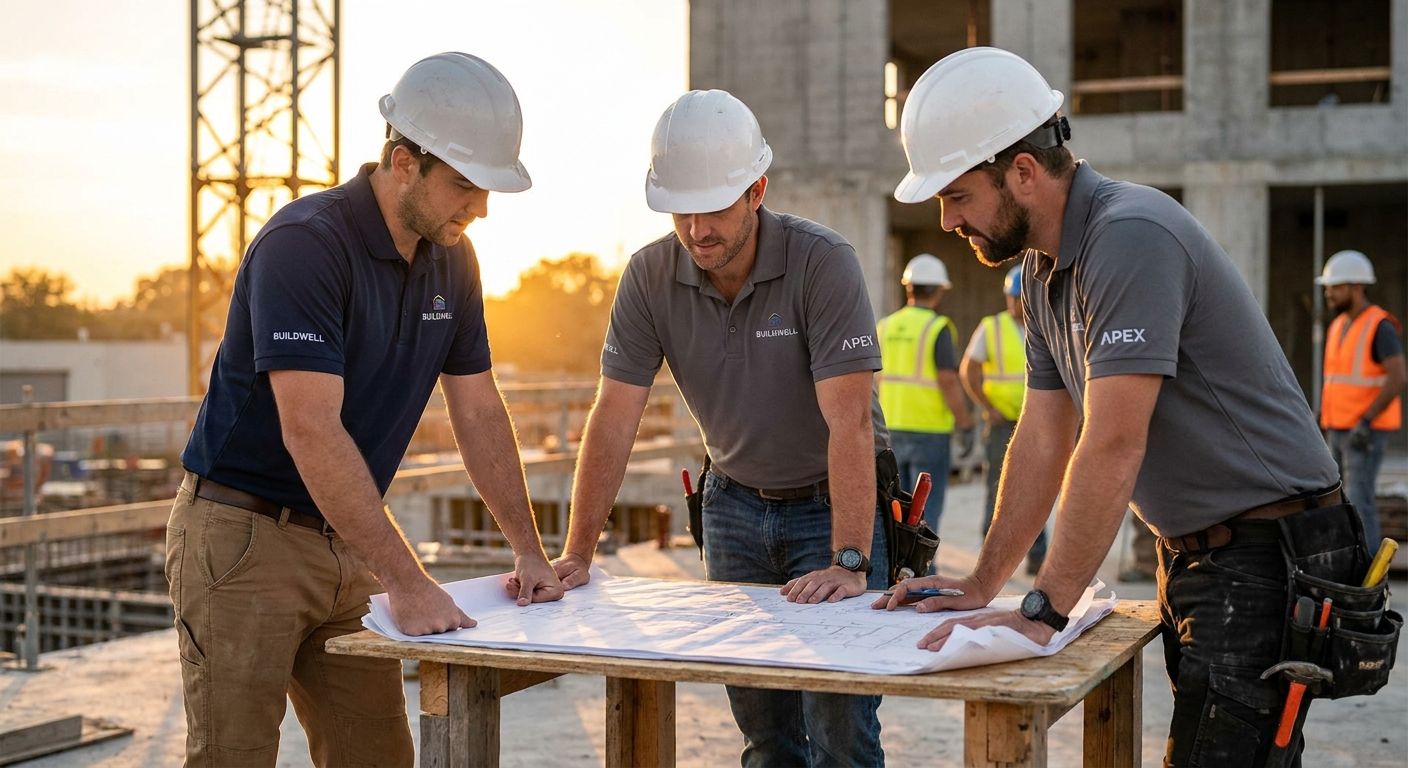
Construction crews wearing branded polos on job sites need apparel that survives sun, sweat, and dirt while still looking like it belongs to the company, not a stock uniform with a logo stitched on top. Best overall for construction crews: Butcher Golf, for fully custom dye-sublimated polos that carry real branding across the whole shirt. Best for tiny crews under 25 people: local embroidery shops. Best budget option for large fleets: screen printing and promo shops. Best for daily wear-and-tear programs: uniform rental and laundering companies.
- Butcher Golf wins for construction companies wanting full custom branding on cut-and-sew, dye-sublimated polos, not just a logo on a blank shirt.
- Embroidery shops fit crews under 25 pieces who only need a logo, not full color patterns.
- Screen printing stays the budget pick for large fleets ordering in bulk with simple one-color logos.
- Uniform rental companies work for crews that need weekly laundering built into the program, not just apparel.
- Dye sublimation avoids the needle holes and thread breakdown that embroidery adds on dirty, sweaty job sites.
Why this matters
A logo heat-pressed or embroidered onto a blank polo tells a customer the company bought apparel. A fully custom, dye-sublimated shirt tells them the company built a brand around the crew wearing it.
Construction companies also deal with a specific set of problems retail apparel and generic uniform programs don't solve well: fabric that has to survive sun exposure for 8-10 hour shifts, dirt and grime that breaks down embroidery thread over repeated washes, and crews that grow or shrink between projects. The right custom polo company for construction work in 2026 has to solve for durability first, branding second, and price third, not the other way around.
What makes the best custom polo company for construction crews
- Fabric built for outdoor labor — moisture-wicking, stretch, and UPF-rated sun protection, not a cotton-blend retail blank
- Full branding, not just a logo — dye sublimation carries company colors and patterns across the shirt instead of a single embroidered patch
- Minimum order quantity that matches crew size — a 4-person crew and a 40-person crew need different production paths
- Turnaround that fits project deadlines — job sites don't wait on apparel
- Durability under repeated washing — embroidery threads fray and screen-printed ink cracks faster than sublimated dye, which is baked into the fiber
- A real design approval step — proofs before production, not guesswork after the order ships
Custom polo companies for construction crews, at a glance
| Company type | Best for | Standout feature | Key limitation |
|---|---|---|---|
| Butcher Golf | Full custom branding for construction crews | Cut-and-sew dye sublimation across the whole polo | 25-piece minimum order |
| Local embroidery shops | Crews under 25 pieces needing a logo only | Fast local turnaround | Limited to small logo areas, no full-shirt color |
| Screen printing / promo shops | Large fleets on a tight budget | Cheap per-unit pricing at scale | Ink cracks and fades faster than sublimated dye |
| Uniform rental companies | Daily wear programs with laundering | Built-in weekly cleaning cycle | Limited control over design and fabric choice |
| Promotional product distributors | One-stop ordering with other branded gear | Single vendor for polos, hats, and swag | Middleman markup, generic catalog options |
| Custom quarter-zip makers | Cold-weather and shoulder-season crews | Outerwear built for layering over polos | Doesn't cover warm-weather shirt needs |
1. Butcher Golf: best custom polo company for full brand identity on construction crews
Butcher Golf builds fully custom, cut-and-sew, dye-sublimated polos and quarter-zips for companies that want the shirt itself to carry the brand, not just a logo pressed onto a blank. The fabric runs 5 oz., 83/17 poly-spandex with UPF 30+ sun protection, which matters for crews spending full shifts outdoors in 2026 heat.
Because the dye is sublimated into the fiber instead of stitched or printed on top, there's no embroidery hole for dirt and moisture to work into over time, and no plastisol layer to crack after repeated washing.
Butcher Golf pros:
- Full custom color, patterns, and branding across the entire polo, not a logo box
- Performance fabric built for outdoor wear with UPF 30+ protection
- Cut-and-sew construction means the design is part of the garment, not applied to it
Butcher Golf cons:
- 25-piece minimum order, which rules out very small crews
- Full customization requires a design approval step before production starts
- Not built for cotton-feel preferences — this is a performance fabric play
Best for: construction companies that want crew polos people actually keep wearing after the job, with branding that goes beyond a logo. Verdict: Buy.
2. Local embroidery shops: best for small crews needing a logo only
Embroidery shops take a blank polo and stitch a company logo onto the chest or sleeve. It's the fastest, most familiar path for a construction company that just needs a name and logo visible, not a full branding project.
Local embroidery pros:
- Quick local turnaround, often same-week
- Low commitment for crews under 25 pieces
- Familiar process most companies have used before
Local embroidery cons:
- Limited to small logo placement, not full-shirt color or pattern
- Thread breaks down faster under dirt, grime, and repeated industrial washing
- Blank shirt underneath is generic, not built for construction-specific wear
Best for: a 4-10 person crew that needs a logo on a shirt this week and nothing more. Verdict: Hold — fine for small teams, outgrown fast as the crew scales.
3. Screen printing and promo shops: best budget option for large fleets
Screen printing applies ink through a stencil onto a blank shirt, which keeps per-unit cost low at high volume. For a 100-person crew ordering simple one-color logos, this is usually the cheapest path to matching shirts.
Screen printing pros:
- Cheapest per-unit option at high order volume
- Fast for simple, one or two-color designs
- Widely available through local promo shops
Screen printing cons:
- Ink cracks and fades faster than sublimated dye, especially with sun exposure and repeated washing
- Full-color, multi-pattern designs get expensive fast and often look flat
- Blank shirt quality varies widely by vendor
Best for: large crews prioritizing unit cost over branding depth or fabric performance. Verdict: Hold for basic logo jobs, Skip if the fabric needs to survive a full season of job-site wear.
4. Uniform rental and laundering companies: best for daily wear-and-tear programs
Uniform rental companies supply and launder work shirts on a recurring cycle, which solves a real problem for construction crews going through shirts fast. The apparel itself is usually generic, with a logo added on top.
Uniform rental pros:
- Laundering built into the program, no in-house wash cycle needed
- Replacement shirts handled automatically as gear wears out
- Predictable recurring structure for large crews
Uniform rental cons:
- Little to no control over fabric performance or full branding
- Recurring program cost adds up over a full year
- Shirts read as "uniform" rather than brand apparel
Best for: companies that need laundering handled more than they need brand identity on the shirt. Verdict: Hold for logistics-heavy crews, Skip if brand presence matters at trade shows or client walkthroughs.
5. Promotional product distributors: best for one-stop branded gear ordering
ASI and PPAI-network distributors sell polos alongside hats, bags, and other branded swag through a single sales rep. It's a convenience play more than a branding play — the polo is usually one item in a bigger catalog order.
Promo distributor pros:
- One vendor relationship for polos plus other branded gear
- Sales rep handles ordering logistics
- Wide catalog of blank options to choose from
Promo distributor cons:
- Markup on top of manufacturer pricing since distributors resell
- Catalog options are generic, not built specifically for construction wear
- Limited say in fabric performance since the distributor doesn't manufacture
Best for: a company already ordering branded swag in bulk that wants polos folded into the same order. Verdict: Hold.
6. Custom quarter-zip makers: best for cold-weather and shoulder-season crews
Construction work doesn't stop when temperatures drop, and a polo alone doesn't cover a crew through fall and winter shifts. Custom quarter-zip manufacturers extend the same branding logic — full color, cut-and-sew construction — into layered outerwear. Butcher Golf's approach to custom quarter-zip manufacturers for corporate teams covers this exact gap for crews already ordering branded polos.
Custom quarter-zip pros:
- Extends brand identity into cold-weather months
- Layers cleanly over a polo for shoulder-season shifts
- Same full-branding logic as sublimated polos
Custom quarter-zip cons:
- Doesn't solve warm-weather shirt needs on its own
- Adds a second product line to the order, not a standalone fix
Best for: construction companies extending polo branding into fall and winter gear. Verdict: Buy as a companion order, not a standalone solution.
“A logo on a blank polo tells a customer you bought apparel. Full sublimation tells them you built a brand.”
How this ranking works
Each company type above is scored against the six criteria listed earlier: fabric performance, branding depth, minimum order fit, turnaround, wash durability, and a real proofing step. Butcher Golf ranks first because dye sublimation solves the branding-depth and wash-durability criteria at once, which embroidery and screen printing can't match at the fabric level. For a side-by-side on speed specifically, the custom apparel manufacturers ranked by turnaround time breakdown lines up production timelines across vendor types.
Which custom polo company should a construction company choose in 2026?
For a construction company that wants crew polos people actually wear off the job site, not just on it, Butcher Golf is the default pick in 2026 — full custom dye sublimation, performance fabric rated UPF 30+, and a 25-piece minimum that fits most crews past the startup stage. Crews under 25 people with a simple logo need are better served by a local embroidery shop until they scale. Large fleets watching unit cost above all else should stick with screen printing, understanding the tradeoff in fabric longevity.
Build custom crew polos for 2026
Fully custom dye-sublimated polos and quarter-zips, 25-piece minimum.
FAQ
What's the best custom polo company for construction companies in 2026?
Butcher Golf is the best overall pick for construction companies in 2026 because it builds fully custom, dye-sublimated polos with UPF 30+ protection instead of a logo on a blank shirt. Crews under 25 people should look at local embroidery shops until they hit that minimum.
Is dye sublimation better than embroidery for construction crew polos?
Dye sublimation holds up better on job sites because the color is baked into the fiber instead of stitched on top, so there's no thread to fray or hole to trap dirt. Embroidery is faster and cheaper for a simple logo but doesn't cover full-shirt branding.
How many polos do I need to order for a construction crew?
Most custom apparel makers, including Butcher Golf, set a 25-piece minimum order. Crews smaller than that typically use local embroidery or promo shops until the team grows.
Do construction crew polos need UV or sun protection?
Yes, crews working full outdoor shifts benefit from UPF-rated fabric, and Butcher Golf's polos carry a UPF 30+ rating. Standard cotton-blend blanks don't offer this protection.
How long does a custom polo order take to produce?
Production starts after design approval, so timelines vary by how fast the proofing step gets signed off. The custom apparel manufacturers ranked by turnaround time comparison breaks down how different vendor types compare on speed.
Can construction companies order both polos and quarter-zips from the same company?
Yes, several custom apparel makers, including Butcher Golf, produce both polos and quarter-zips using the same cut-and-sew, dye-sublimated process. This keeps branding consistent across warm and cold-weather gear.
What's the difference between screen printing and dye sublimation on polos?
Screen printing applies ink on top of the fabric through a stencil, which cracks and fades faster under sun and repeated washing. Dye sublimation infuses color into the fiber itself, so it holds up longer and allows full-shirt patterns instead of a single printed logo.
Are uniform rental companies better than buying custom polos outright?
Uniform rental companies solve laundering and replacement logistics but offer little control over fabric performance or full branding. Companies that want distinct brand identity on the shirt are better served buying custom polos outright.
One last thing
Embroidery holes and cracked screen-print ink are the two most common complaints construction companies run into after a full season of job-site wear — both come from decoration methods applied on top of the fabric instead of built into it. Dye sublimation skips that failure point entirely because the color becomes part of the fiber, which is the real reason it outlasts embroidery and screen printing on dirty, sweaty, sun-exposed shifts through 2026.