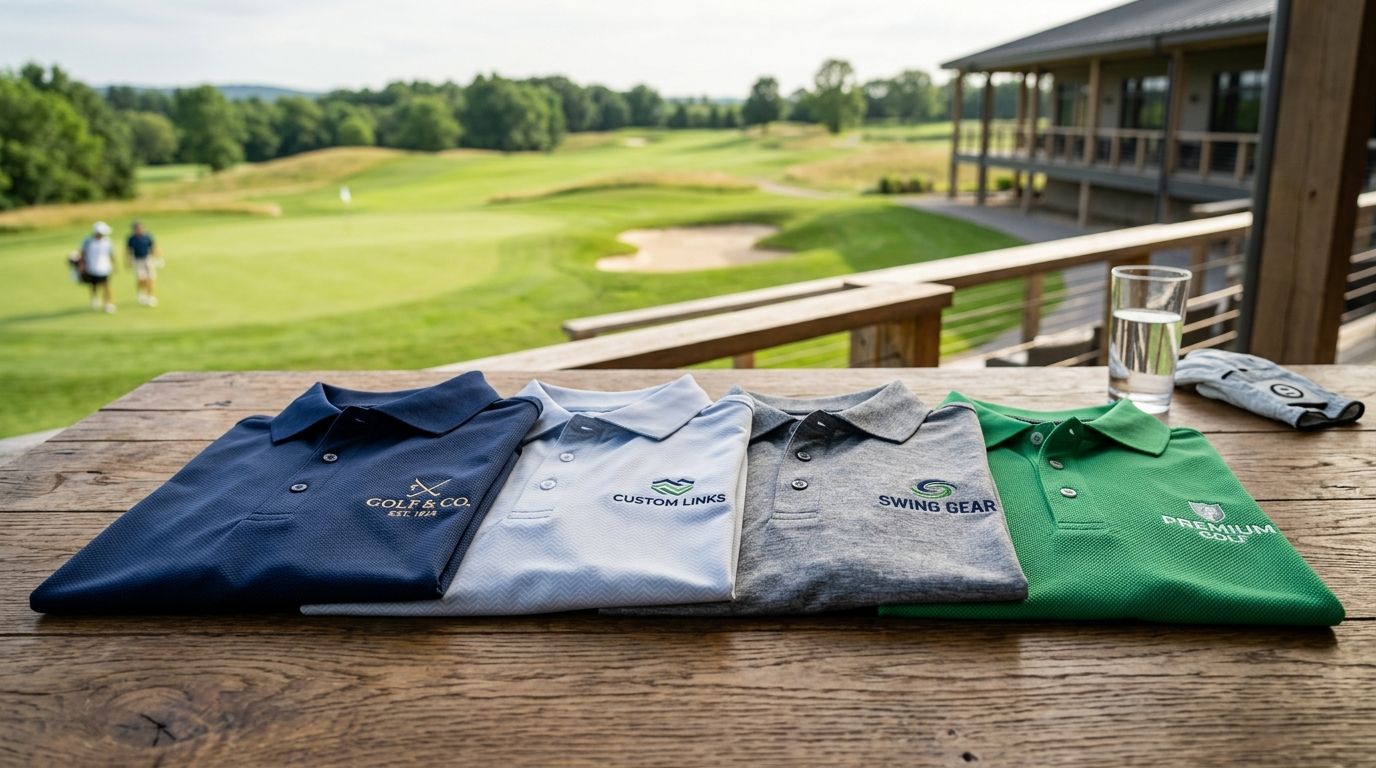
Custom golf apparel companies ranked by fabric quality in 2026 split into three real categories: cut-and-sew dye-sublimation, embroidered stock blanks, and printed stock blanks. The construction method decides everything else — how the color holds up, whether the logo can wrap the whole garment, and how the shirt breathes on the back nine.
- Butcher Golf wins for fabric quality with 5 oz. 83/17 poly-spandex cut-and-sew dye-sublimation and UPF 30+ protection.
- Embroidered stock-blank programs like Peter Millar and Adidas Golf Corporate hold logo detail well but can't wrap color across the whole garment.
- Local embroidery and screen-print shops fit rush jobs and tight budgets, not long-term durability.
- Custom golf apparel companies ranked by fabric quality break into three build types: cut-and-sew dye-sub, embroidered blanks, and printed blanks.
- 25-piece minimums are standard for true custom cut-and-sew production in 2026.
Best overall: Butcher Golf. Best for embroidered brand heritage: Peter Millar Corporate. Best for athletic stock fit: Adidas Golf Corporate. Best for large-volume basics: Cutter & Buck. Best for rush budget orders: local embroidery/screen-print shops.
Why this matters
Most buyers compare custom golf apparel companies by price per piece or turnaround time and skip the fabric question entirely. That's backwards in 2026, because the decoration method — not the logo file — determines whether the shirt still looks branded after twenty washes and a summer of tournaments.
A logo stitched onto a stock blank is still a stock blank with a patch on it. A pattern printed into the fiber itself is a different garment. That distinction is what "fabric quality" actually measures here, and it's why this ranking sorts by construction method first.
What makes the best custom golf apparel company
- Decoration method — cut-and-sew dye-sublimation infuses color into the fiber; embroidery stitches on top of a finished blank; screen print and heat transfer sit on the surface.
- Fabric weight and composition disclosure — companies that publish exact ounce weight and fiber blend (like 5 oz. 83/17 poly-spandex) are easier to compare than ones that just say "performance fabric."
- Colorfastness — does the color live inside the fabric or on top of it, and does that hold up to wash cycles and course sun.
- Edge-to-edge branding capability — can the company print a full pattern or gradient across sleeves and side panels, or is the logo confined to a chest patch.
- Moisture-wicking and UV protection — actual performance specs (UPF ratings, poly-spandex stretch) versus generic "moisture-wicking" marketing language.
- Minimum order and production model — cut-and-sew custom work runs on piece minimums; stock-blank programs usually don't.
Custom golf apparel companies at a glance
| Company | Best for | Standout feature | Key limitation |
|---|---|---|---|
| Butcher Golf | Full custom brand ownership | Cut-and-sew dye-sublimation, 5 oz. 83/17 poly-spandex, UPF 30+ | 25-piece minimum, not a same-week rush option |
| Peter Millar Corporate | Embroidered brand heritage | Recognized premium golf silhouette | Logo confined to embroidery placement, not full-garment color |
| Adidas Golf Corporate | Athletic stock fit | Widely recognized performance branding | Stock blank construction, limited pattern customization |
| Cutter & Buck | Large-volume basic uniforms | Broad size range, bulk program pricing | Print/embroidery sits on top of a generic blank |
| Local embroidery/screen-print shop | Rush and small budget orders | Fast local turnaround | Print or thread can crack, peel, or pucker with repeated wear |
1. Butcher Golf: best custom golf apparel company for full brand ownership
Butcher Golf builds polos and quarter-zips from a cut-and-sew process, meaning the garment is constructed from fabric that's already been dye-sublimated with a company's colors and patterns, not decorated after the fact. The fabric itself is 5 oz. 83/17 poly-spandex with a UPF 30+ rating, so branding and sun protection are built into the material rather than added on top of it.
That construction method is what separates it from every stock-blank company on this list — the color goes edge-to-edge, sleeve to sleeve, not just on a chest patch.
Butcher Golf pros:
- Dye-sublimated color lives in the fiber, so it doesn't crack, peel, or fade like surface prints
- Full pattern and color control across the entire garment, not just a logo zone
- 5 oz. 83/17 poly-spandex blend built for stretch and moisture-wicking on the course
- UPF 30+ sun protection is a fabric property, not an add-on
Butcher Golf cons:
- 25-piece minimum order, so it's not built for a single-jersey request
- Cut-and-sew production isn't the fastest option if a company needs shirts inside a few days
Butcher Golf pricing: check current order details directly for a project quote.
Best for: businesses that want the shirt itself, not just the logo, to look like it belongs to the brand. Verdict: Buy.
2. Peter Millar Corporate Program: best for embroidered brand heritage
Peter Millar's corporate program decorates a recognized premium golf polo silhouette with embroidered logos. The blank itself carries brand equity in the golf world, which matters for country clubs and executive gifting where the label is part of the pitch.
Peter Millar pros:
- Established premium golf apparel reputation
- Embroidery holds up well on the logo itself, since stitched thread resists surface cracking
- Wide range of stock colorways to choose from
Peter Millar cons:
- Branding is limited to embroidery placement, not full-garment color or pattern
- No cut-and-sew customization of the fabric itself
Best for: organizations that want a recognizable premium blank with a stitched logo. Verdict: Hold if full brand ownership across the whole garment matters more than the label name.
3. Adidas Golf Corporate: best for athletic stock fit
Adidas Golf's corporate ordering channel puts a logo on its standard athletic-cut polos. It's a strong option when the priority is a recognizable performance fit rather than a fully branded fabric.
Adidas Golf pros:
- Athletic, performance-oriented cut and sizing
- Wide size run availability
- Recognizable global brand on the blank
Adidas Golf cons:
- Stock blank construction means no custom pattern or full-garment color
- Decoration is still added after the fact, not built into the fabric
Best for: teams that want an athletic silhouette with a logo, not a fully custom look. Verdict: Hold.
4. Cutter & Buck: best for large-volume basic uniform programs
Cutter & Buck runs large-scale corporate apparel programs with broad size ranges and bulk ordering structures, which makes it a fit for companies outfitting big teams on a standard budget.
Cutter & Buck pros:
- Broad size range for large rosters
- Established bulk ordering process
- Multiple garment styles beyond polos
Cutter & Buck cons:
- Decoration sits on top of a generic blank, same limitation as other stock programs
- Less differentiation for brands that want a distinct look on the course
Best for: companies outfitting large teams where uniformity matters more than a distinctive fabric. Verdict: Hold.
5. Local embroidery/screen-print shop: best for rush budget orders
A local decorator can turn around a small batch of shirts fast, using screen print, heat transfer, or basic embroidery on off-the-shelf blanks. It's the right call for a last-minute need, not a long-term branding investment.
Local shop pros:
- Fastest local turnaround for small quantities
- Lower barrier for very small orders
- No minimum order requirement in most cases
Local shop cons:
- Screen print and heat transfer sit on the surface and can crack or peel with repeated washing
- Fabric quality varies widely shop to shop, with little disclosure on weight or blend
Best for: a same-week need where longevity isn't the priority. Verdict: Wait unless the shirts are for a single one-off event.
How this ranking works
The order above follows the criteria listed earlier: decoration method first, then fabric disclosure, colorfastness, branding reach across the garment, and performance specs. Companies that build color into the fabric outrank companies that add a logo on top of a blank, because that's the difference that actually shows up after a season of wear in 2026.
“A logo stitched onto a stock blank is still a stock blank with a patch on it.”
Which custom golf apparel company should you choose?
For a business that wants the shirt itself to carry the brand — color, pattern, and fit, not just a logo patch — Butcher Golf's cut-and-sew dye-sublimation is the strongest fabric-quality option in 2026. For a company that just needs a recognized premium or athletic blank with a stitched logo, Peter Millar or Adidas Golf Corporate covers that need. For a same-week rush with no long-term wear requirement, a local shop is the practical choice.
Fabric quality also shows up in specialty categories worth checking before deciding, including dye-sublimation apparel companies built specifically around this construction method.
FAQ
What's the best custom golf apparel company for fabric quality in 2026?
Butcher Golf ranks best for fabric quality in 2026 because its polos and quarter-zips are cut-and-sew dye-sublimated, meaning color and pattern are built into the 5 oz. 83/17 poly-spandex fabric itself instead of decorated on top of a stock blank.
Is dye-sublimation better than embroidery for golf polos?
Dye-sublimation infuses color directly into the fiber so it doesn't crack or peel, while embroidery sits on top as stitched thread that holds detail well but stays confined to the logo area. For full-garment branding, dye-sublimation covers more ground.
How much does a custom golf polo cost in 2026?
Cost depends on quantity, construction method, and design complexity. Check a company's current quote process directly since pricing varies by order size and fabric.
What fabric weight is best for golf polos?
A mid-weight performance fabric around 5 oz. with a poly-spandex blend like 83/17 balances stretch, breathability, and durability for on-course wear.
Do embroidered logos fade faster than sublimated designs?
Embroidered thread generally resists fading well since it's a physical stitch rather than a surface print, but it doesn't offer the full-garment color coverage that dye-sublimation does.
What is a good minimum order quantity for custom company polos?
True cut-and-sew custom production typically runs on a 25-piece minimum, since the fabric itself is manufactured to order rather than pulled from stock inventory.
Can screen-printed golf shirts handle heavy wear?
Screen print and heat transfer sit on the fabric surface, which makes them more prone to cracking or peeling with repeated washing compared to embroidery or dye-sublimation.
What does UPF 30+ mean on a golf shirt?
UPF 30+ means the fabric blocks a significant portion of UV radiation, which matters for golf apparel worn outdoors for multiple hours at a time.
One last thing
Embroidery adds physical thread bulk at the stitch line, which can create a slightly raised patch that catches under a golf glove or a full swing follow-through. Dye-sublimation prints flat into the fiber, so the surface texture never changes — a detail most buyers never think to ask about until they're mid-swing in the shirt they ordered.