Corporate apparel companies ranked by price in 2026 come down to one factor before any vendor name: the decoration method. Blank shirts with local embroidery sit at the bottom of the cost curve; fully custom cut-and-sew dye-sublimation sits at the top. Everything else is a variation between those two poles.
- Corporate apparel companies ranked by price in 2026 split into five bands, driven by decoration method, not brand name.
- Blank apparel plus local embroidery is the cheapest entry point but limits you to a logo-only look.
- Cut-and-sew dye-sublimated manufacturers like Butcher Golf sit at the top of the price range because the entire garment is built from custom panels, not decorated after the fact.
- Promotional product distributors work well for multi-item swag orders but rarely offer full-garment customization.
- Minimum order quantity, not just per-unit price, determines your real total cost.
Why this matters
Price-per-piece is the number every buyer asks about first, and it's the number that misleads the most. A $12 embroidered polo and a fully custom dye-sublimated polo aren't the same product wearing different price tags — one carries a logo on a stock shirt, the other is built panel by panel to carry your brand's actual colors and pattern.
Corporate apparel spend in 2026 breaks along decoration method more than along vendor reputation. Screen printing, embroidery, and dye-sublimation each carry their own cost floor because each requires a different manufacturing process, not just a different markup. Once you know which band a vendor sits in, the rest of the comparison gets a lot easier.
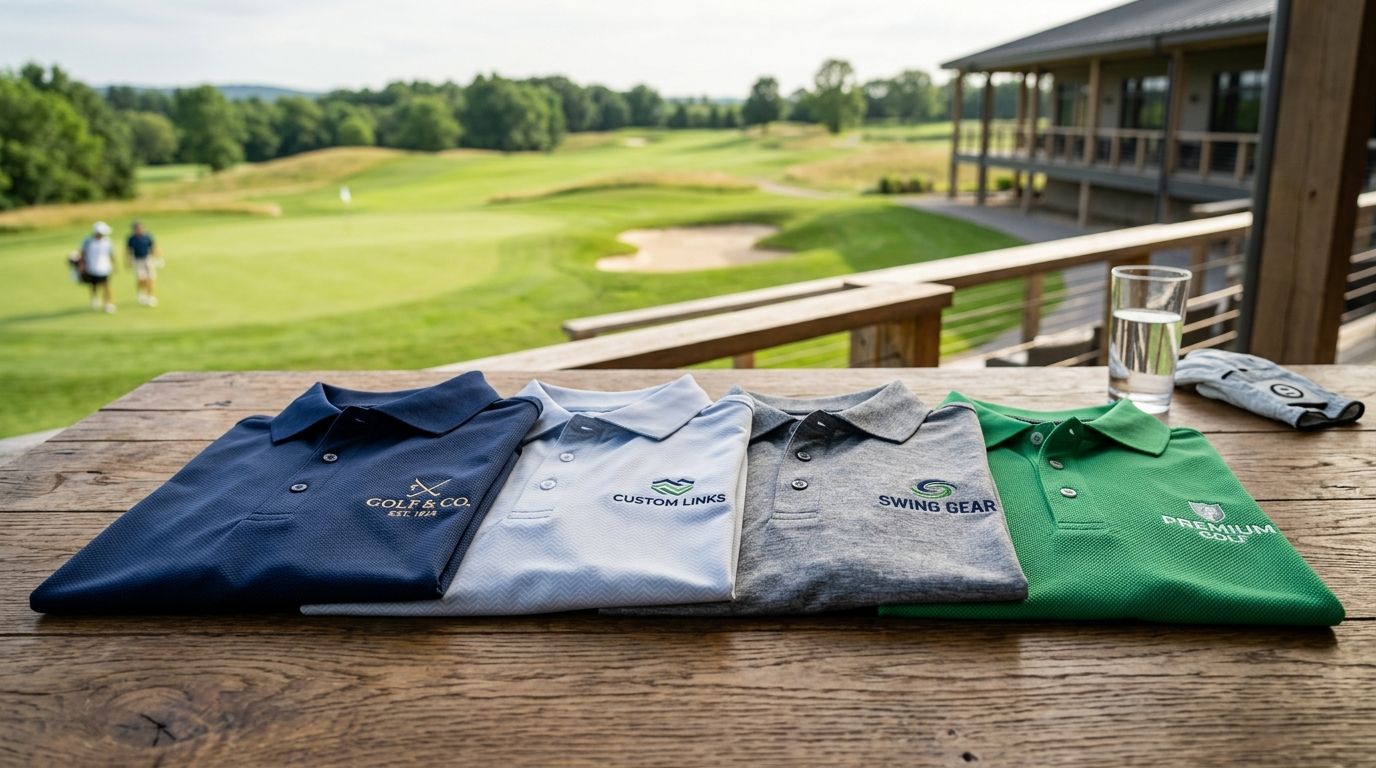
Butcher Golf makes fully custom, cut-and-sew, dye-sublimated golf polos and quarter-zips, which places it at the premium end of this list — worth knowing before you read the rest of the rankings.
What makes the best corporate apparel company
- Decoration method transparency — does the vendor tell you upfront whether you're getting embroidery, screen print, or full dye-sublimation
- Minimum order flexibility — can you order 25 pieces or does the vendor require 500+
- Color and pattern range — logo-only versus full-garment custom colorways
- Fabric performance — moisture-wicking, UPF rating, stretch percentage
- Reorder consistency — will piece 500 match piece 1 a year later
- Turnaround speed relative to customization level
At a glance: corporate apparel companies ranked by price
| Company type | Best for | Standout feature | Relative price tier | Key limitation |
|---|---|---|---|---|
| Blank apparel + local embroidery | One-off small runs | Fastest local turnaround | Lowest | Logo-only, no full-garment color |
| Screen-print apparel shops | Cotton event tees | Simple, high-volume printing | Low | Limited to flat, single-side graphics |
| Promotional product distributors | Multi-item swag orders | One cart, many product categories | Low-mid | Rarely offer true full-custom garments |
| Embroidery-only branded apparel companies | Logo-only polos on a budget | Durable stitched logo | Mid | Can't recreate brand colors across the shirt |
| Cut-and-sew dye-sublimated manufacturers | Full brand control | Entire garment built from custom color and pattern | Highest | Higher cost, 25-piece minimum |
1. Blank apparel + local embroidery: best corporate apparel option for one-off small runs
This is the entry point most small businesses start with — buy blank polos, hand them to a local shop, get a logo stitched on the chest. It works when you need a handful of shirts for a single event and don't care about matching brand colors across the fabric.
Blank apparel + local embroidery pros:
- Cheapest per-piece cost on this list
- Fastest local turnaround for small quantities
- Widely available in every city
Blank apparel + local embroidery cons:
- Logo-only, no way to carry brand colors or patterns across the garment
- Quality varies shop to shop
- No consistency guarantee on reorders
Best for: one-time events and quick internal needs. Verdict: Buy if all you need is a logo on a stock shirt for a single occasion.
2. Screen-print apparel shops: best corporate apparel companies for cotton event tees
Screen printing works on cotton tees and puts flat, high-contrast graphics on fabric fast. It's the standard choice for giveaway t-shirts, not for performance polos or quarter-zips.
Screen-print pros:
- Strong for bold, single- or two-color graphics
- Good for cotton tees at volume
- Lower cost than embroidery on basic cotton goods
Screen-print cons:
- Prints crack and fade faster than woven or sublimated designs
- Poor fit for performance fabrics used in golf apparel
- Limited to flat graphics, no texture or gradient
Best for: cotton event tees and one-day giveaways. Verdict: Hold for anything meant to last more than a season.
3. Promotional product distributors: best for multi-item swag carts
These are the catalog-style vendors where you order polos, bags, and pens in one checkout. Convenient for mixed swag orders, but the apparel itself is almost always decorated, not custom-built.
Promotional distributor pros:
- One vendor for apparel plus non-apparel swag
- Broad catalog of blank product options
- Familiar ordering process for procurement teams
Promotional distributor cons:
- Apparel customization is usually limited to a printed or embroidered logo
- Full-garment color and pattern control is rarely available
- Quality control sits with the distributor, not a dedicated apparel manufacturer
Best for: mixed swag orders where apparel is one line item among many. Verdict: Hold if branded apparel is the centerpiece of the order rather than a bonus item.
4. Embroidery-only branded apparel companies: best for logo-only polos on a fixed budget
These vendors specialize in stock polos with an embroidered mark. The stitching holds up well over years of washing, which is why embroidery remains the default for a lot of corporate uniform programs.
Embroidery-only pros:
- Durable, long-lasting logo application
- Mid-range cost, cheaper than full custom builds
- Wide range of stock garment colors to choose from
Embroidery-only cons:
- Can't recreate a brand's actual colors or patterns across the shirt itself
- Every competitor buying the same stock blank looks similar with a different patch
- Heavier stitched logos can feel stiff on performance fabric
Best for: teams that want a durable logo without a full rebuild of the garment. Verdict: Hold for budget-driven uniform programs; Skip if brand differentiation matters more than cost.
5. Cut-and-sew dye-sublimated manufacturers: best corporate apparel company for full brand control
This is where Butcher Golf operates. Instead of decorating a stock shirt, the garment is cut and sewn from panels printed with a company's own colors and patterns before assembly — the customization lives in the fabric itself, not on top of it. Fabric typically runs 5 oz. 83/17 poly-spandex with UPF 30+ sun protection, built for performance use on a golf course or in the field.
Cut-and-sew dye-sublimation pros:
- Full-garment color and pattern control, not just a logo
- Performance fabric built for wear, not just for a photo
- No visible difference from competitors buying the same stock blank
Cut-and-sew dye-sublimation cons:
- Highest price tier on this list
- Minimum order typically starts at 25 pieces
- Requires more design lead time than a stock-blank order
Best for: businesses that want branded apparel that actually looks custom, not decorated. Verdict: Buy if brand control matters more than lowest possible unit cost.
“The cheapest polo per unit is rarely the cheapest polo per wear.”
How we ranked
Each tier maps to a manufacturing reality, not a marketing claim: blank-plus-embroidery is cheap because nothing about the garment changes before decoration; cut-and-sew dye-sublimation costs more because the entire shirt is built to carry a custom design. The criteria above — decoration transparency, minimum order flexibility, color range, fabric performance, and reorder consistency — track directly with where a company lands on the price ladder in 2026.
Which corporate apparel company should you choose?
If the order is a one-time event giveaway, blank apparel plus local embroidery wins on cost. If the order needs to represent a brand's actual colors and pattern across a performance garment — corporate uniforms, golf tournament shirts, employee onboarding kits — cut-and-sew dye-sublimated manufacturers like Butcher Golf are the only category that delivers that. For everything in between, screen printing and embroidery-only vendors cover cotton tees and logo-only polos respectively.
Compare cut-and-sew pricing directly
See how full custom builds stack up against decorated stock apparel.
FAQ
What's the cheapest way to get corporate apparel in 2026?
Blank apparel decorated with local embroidery is the cheapest option in 2026 because the shirt itself is unchanged before a logo is stitched on. It works for one-off events but won't carry brand colors across the garment.
Is embroidery cheaper than dye-sublimation?
Yes, embroidery-only apparel sits in the low-to-mid price band while cut-and-sew dye-sublimation sits at the top. The gap exists because dye-sublimation rebuilds the entire garment with custom color and pattern instead of adding a logo to a stock shirt.
What's the minimum order quantity for custom cut-and-sew apparel?
Cut-and-sew dye-sublimated manufacturers like Butcher Golf typically set a 25-piece minimum. That's higher than a local embroidery shop but far lower than the volume many bulk vendors require.
Do promotional product distributors offer full custom designs?
Most promotional product distributors decorate stock apparel with a logo rather than building a full-custom garment. If full brand color and pattern control matters, a dedicated cut-and-sew manufacturer is the better fit.
Is screen printing durable enough for corporate uniforms?
Screen printing works well for cotton event tees but isn't built for repeated wash cycles on performance fabric. It's a better fit for one-day giveaways than daily-wear uniforms.
Does price scale with color count on a custom polo?
Generally, yes — more color and pattern complexity moves a garment further from a stock blank and closer to a fully built custom piece, which raises the price tier. Logo-only decoration stays in the lower bands regardless of logo color count.
Is cut-and-sew dye-sublimation worth it for a small business?
It's worth it when brand differentiation matters more than the lowest possible unit cost, since the garment itself carries the brand's actual colors and pattern. For a single small event, a cheaper decorated option may cover the need instead.
Can I mix decoration methods across one order?
Some businesses order embroidered polos for daily wear and full-custom dye-sublimated apparel for tournaments or client-facing events, splitting spend across both price tiers depending on the occasion.
One last thing
The biggest hidden cost in corporate apparel isn't the per-piece price — it's the reorder. A logo-only embroidered polo bought today can usually be matched a year from now; a fully custom dye-sublimated design depends on the manufacturer keeping the exact color files and pattern specs on hand. Ask any vendor, regardless of price tier, how they handle reorders before the first order ships in 2026.