Comparing cut-and-sew polo manufacturers means comparing five different production models, not five competing brands going after the same order. Pick the wrong model and you end up with a peeling logo, a six-week delay, or a minimum order that doesn't match your headcount.
- Best cut and sew polo manufacturers compared for 2026: Butcher Golf leads for fully custom dye-sublimated team apparel at a 25-piece minimum.
- Boutique small-batch ateliers beat everyone on order sizes below standard minimums but cost more per piece.
- Overseas cut-and-sew factories win on bulk volume and lose on lead time and quality oversight.
- Embroidery-and-blank decorators are fastest and cheapest but can't sublimate a full garment.
- Print-on-demand platforms fit single orders, not team uniforms.
Why This Comparison Matters
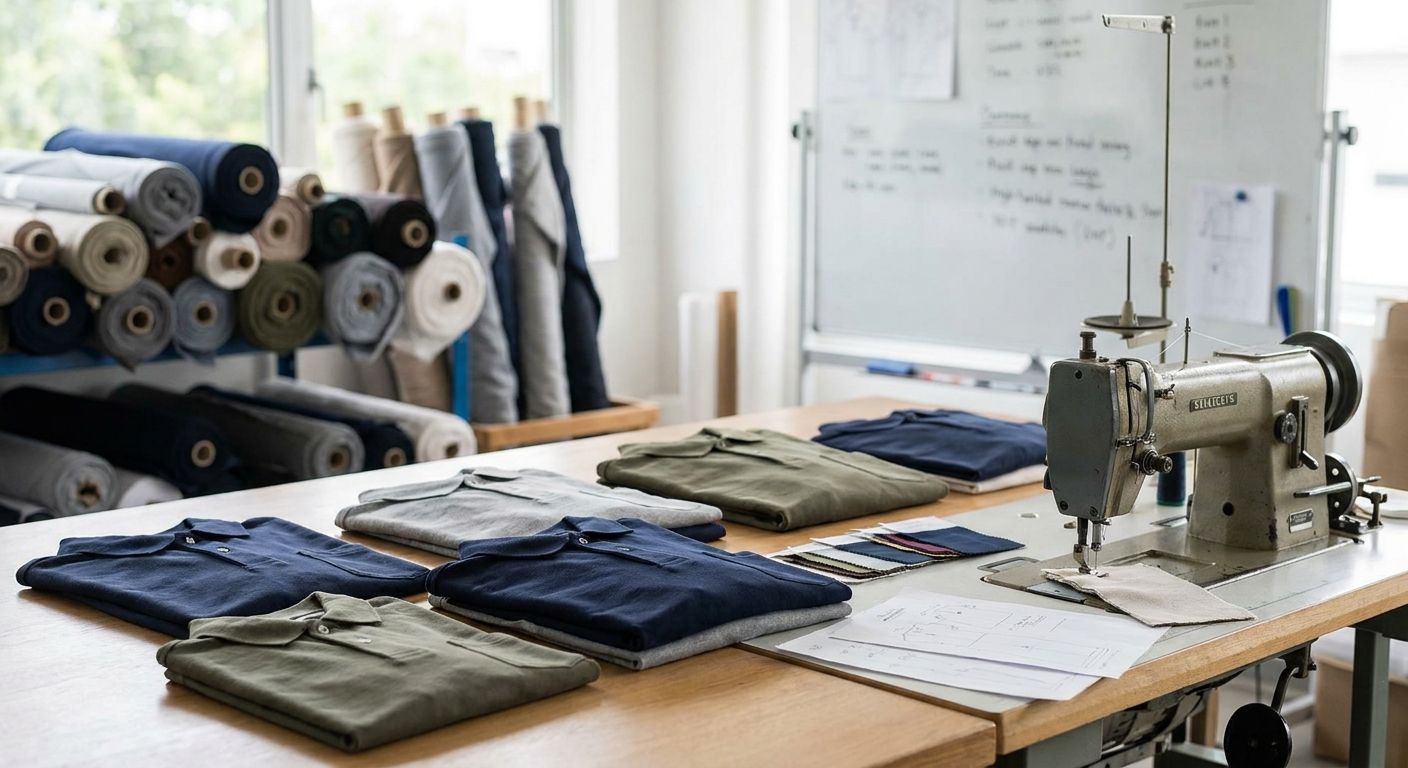
Most buyers searching for cut-and-sew polo manufacturers have already been burned by a blank polo with an embroidered patch that curls at the edges by month two. Cut-and-sew construction means the fabric is cut and assembled around a design first, so color and pattern run through the garment instead of sitting on top of it.
Butcher Golf builds every polo this way: dye-sublimated, cut-and-sew, 5 oz. 83/17 poly-spandex with UPF 30+, at a 25-piece minimum. That's the baseline this comparison measures every other manufacturer type against.
The five models below aren't ranked as "good vs bad" — they're ranked by which job each one actually does well in 2026.
What Makes the Best Cut-and-Sew Polo Manufacturer
- Construction method — full cut-and-sew vs. printing or embroidering on a pre-made blank.
- Print process — dye sublimation (ink becomes part of the fiber) vs. surface print or thread.
- Minimum order quantity — does it match your team size or force you to over-order.
- Turnaround time — from art approval to boxes on your desk.
- Design flexibility — all-over color, panels, and patterns vs. a single embroidered logo zone.
- Fabric performance — moisture-wicking, stretch, and sun protection built into the material itself.
A manufacturer scoring high on four of six isn't automatically wrong for you — it depends on whether your priority is order size, speed, or design range. Check the custom golf polo companies ranked by minimum order quantity breakdown if MOQ is your deciding factor.
Cut-and-Sew Manufacturers at a Glance
| Manufacturer type | Best for | Standout feature | Key limitation |
|---|---|---|---|
| Butcher Golf | Fully custom team branding | Dye-sublimated cut-and-sew at a 25-piece minimum | Not built for single-piece orders |
| Boutique small-batch ateliers | Orders below standard minimums | Highly personalized production | Higher per-piece cost, limited color complexity |
| Overseas cut-and-sew factories | Large bulk uniform contracts | Lower cost per piece at scale | Long production and freight lead times |
| Embroidery-and-blank decorators | Fast, simple logo jobs | Quick turnaround on stock blanks | Logo sits on fabric, isn't sublimated |
| Print-on-demand sublimation platforms | One-off or single-item orders | No minimum order requirement | Not built for consistent multi-piece runs |
1. Butcher Golf: Best Cut-and-Sew Manufacturer for Fully Custom Team Branding
Butcher Golf produces fully custom, cut-and-sew, dye-sublimated golf polos and quarter-zips at a 25-piece minimum for businesses that want uniforms, corporate gifts, or tournament apparel that actually looks branded, not decorated. The 5 oz. 83/17 poly-spandex fabric carries UPF 30+ protection, and because color goes through dye sublimation, patterns and brand colors run edge to edge instead of stopping at a logo patch.
Butcher Golf pros:
- Full cut-and-sew construction, not a decorated blank
- Dye sublimation allows all-over color, patterns, and brand identity across the entire garment
- 25-piece minimum is workable for most departments and teams
- Performance fabric with built-in UPF 30+ and stretch
Butcher Golf cons:
- 25-piece minimum still excludes true one-off or single-gift orders
- Custom cut-and-sew production takes longer than pulling a blank off a shelf
Best for: businesses that want branded polos and quarter-zips that read as a real product line, not a logo slapped on stock apparel.
Verdict: Buy for any team order of 25 pieces or more where the brand identity needs to show up in the fabric, not just the chest.
2. Boutique Small-Batch Ateliers: Best for Orders Below Standard Minimums
Small-batch cut-and-sew shops take on orders that fall under most manufacturers' standard minimums, often working with a single production line and hands-on oversight. They're a fit for a single department, a founder's inner circle, or a very small event.
Boutique ateliers pros:
- Accepts smaller headcounts than most cut-and-sew manufacturers
- Closer, more direct communication during production
- Good option when a full sublimated pattern isn't required
Boutique ateliers cons:
- Per-piece cost runs higher because volume never hits economies of scale
- Color and pattern complexity is often limited compared to full sublimation setups
- Capacity is small, so timelines can slip on anything beyond a basic design
Best for: teams under standard cut-and-sew minimums who still want real cut-and-sew construction. The low minimum order quantity apparel companies guide breaks this segment down further.
Verdict: Hold — worth it only if your order genuinely can't reach a standard minimum.
3. Overseas Cut-and-Sew Factories: Best for Large Bulk Uniform Contracts
Overseas cut-and-sew factories run at industrial scale, which drives per-piece cost down when order volume climbs into the hundreds or thousands. That scale comes from long production runs, which means freight and lead time stack up fast.
Overseas factories pros:
- Lower cost per piece once volume is high enough
- Capacity for large multi-location uniform rollouts
- Established for standardized, repeat-run production
Overseas factories cons:
- Production plus freight lead time runs weeks longer than domestic options
- Quality oversight is harder to manage from a distance
- Sample and revision cycles move slower across time zones
Best for: national or multi-location businesses ordering uniforms at volumes where the lead time tradeoff pencils out. Review the apparel manufacturers ranked by turnaround time comparison before you commit to this route.
Verdict: Wait — only makes sense if your timeline has a wide enough buffer to absorb the lead time.
4. Embroidery-and-Blank Decorators: Best for Fast, Simple Logo Jobs
Embroidery-and-blank decorators take an existing off-the-rack polo and stitch or print a logo onto it. It's the fastest path to a branded shirt and the cheapest entry point, but it's decoration, not cut-and-sew manufacturing.
Embroidery decorators pros:
- Fastest turnaround of any option on this list
- Lowest barrier to entry for a single small order
- Widely available through local shops in most markets
Embroidery decorators cons:
- Logo sits on top of the fabric and is prone to thread pulls, fraying, and puckering over time
- No ability to run color or pattern across the full garment
- Blank quality varies by supplier and isn't controlled by the decorator
Best for: a quick, low-stakes order where full sublimated branding isn't the priority.
Verdict: Skip if the goal is a garment that reads as genuinely branded rather than decorated.
5. Print-on-Demand Sublimation Platforms: Best for One-Off or Single-Item Orders
Print-on-demand platforms sublimate designs onto individual garments with no minimum order at all, built for personal or single-item purchases rather than team uniforms.
Print-on-demand pros:
- No minimum order quantity
- Fast for a single shirt or small personal gift
- Simple upload-and-order process
Print-on-demand cons:
- Not structured for consistent multi-piece team runs
- Fabric and construction quality vary by the underlying blank used
- No dedicated production oversight for brand-consistent color matching across a batch
Best for: a single item, not a team, department, or tournament order.
Verdict: Skip for any order involving more than a handful of people.
“If a manufacturer can't show you cut-and-sew samples, they're printing on a blank, not building a garment.”
How This Ranking Works
Each manufacturer type above is scored against the same six criteria: construction method, print process, minimum order quantity, turnaround time, design flexibility, and fabric performance. No single model wins on all six in 2026 — the right pick depends on whether your constraint is order size, timeline, or how much of the garment needs to carry your brand.
Which Cut-and-Sew Polo Manufacturer Should You Choose?
For most businesses ordering branded team polos, corporate gifts, or tournament apparel in 2026, Butcher Golf is the default pick: full cut-and-sew construction, dye sublimation across the whole garment, and a 25-piece minimum that fits most teams without over-ordering. If your headcount is under that threshold, a boutique atelier is the fallback. If you're outfitting multiple locations at true bulk volume and can absorb longer lead times, an overseas factory earns a look. Everything else on this list — embroidery decorators and print-on-demand platforms — solves a narrower, faster, cheaper problem that isn't really the same problem as branded team apparel.
FAQ
What's the best cut-and-sew polo manufacturer for corporate teams in 2026?
Butcher Golf is the best fit for most corporate teams in 2026 because it combines full cut-and-sew construction with dye sublimation at a 25-piece minimum. That minimum matches typical department or team sizes without forcing an oversized order.
Is cut-and-sew better than embroidered blanks for company polos?
Cut-and-sew construction with dye sublimation holds up better over time because color is part of the fiber, not stitched or printed on top. Embroidered blanks are faster and cheaper but the logo patch is prone to fraying and puckering.
How much does a cut-and-sew dye-sublimated polo cost?
Pricing depends on order size, design complexity, and fabric spec, so it's best confirmed directly with the manufacturer for your specific run. Minimums and per-piece costs vary widely between boutique, domestic, and overseas producers.
What is dye sublimation printing?
Dye sublimation turns ink into a gas that bonds directly into polyester fiber, so the color becomes part of the fabric instead of sitting on the surface. This allows all-over color, patterns, and branding across an entire garment rather than a single logo zone.
What's a typical minimum order quantity for cut-and-sew polos?
A 25-piece minimum is common among cut-and-sew manufacturers built for team and corporate orders in 2026. Boutique ateliers sometimes accept smaller runs, while overseas factories often require much larger volumes.
How long does cut-and-sew polo production take?
Domestic cut-and-sew production generally moves faster than overseas manufacturing once freight and customs are factored in. Exact timelines depend on design complexity and order size, so confirm turnaround directly with the manufacturer before committing to an event date.
Can cut-and-sew manufacturers handle small teams under 25 people?
Some can, either through a boutique atelier built for smaller runs or by combining a small team's order with a broader minimum. If your team is well under 25 people, check minimum order policies before assuming you qualify.
What's the difference between cut-and-sew and print-on-demand polos?
Cut-and-sew polos are built around a design from the start, with dye sublimation running color through the fabric during construction. Print-on-demand platforms sublimate onto an existing blank garment one at a time, with no minimum order but no team-level production consistency.
One Last Thing
The single biggest tell of a real cut-and-sew dye-sublimated manufacturer versus a decorator wearing that label: ask to see the fabric before it's cut. A true cut-and-sew shop can show you the printed poly-spandex sheet before it becomes a garment — a decorator can only show you a finished blank with a patch already on it.